Happy Thanksgiving, America!
As I eat my turkey today, one of the biggest things I'll be thankful for is this blog. I'm grateful for the opportunity to write about the things I love best: books, authors, and writing itself. I'm grateful for an audience, not just in the United States, but in Russia, Germany and other European and North American countries. I'm grateful for the ability to put my writing out into the world so easily. Though I still love writing short stories and working on my novel, there's something particularly satisfying about blogging, because I'm creating something that will connect with people instantly.
And because I rarely write about myself except in relation to reading, here are some other things I'm thankful for today.
First the big things: my loving, supportive husband, who makes my life better and happier in every way; my family, who I'm so fortunate to be close to; my friends, who are like my family; my beautiful home, decorated for Christmas; my adorable cats; a good job that helps provide for my family; my love of creating things and determination to see them completed.
And now the small things: really good coffee; Christmas cookies; that anticipatory smell of snow in the air; flowers on the kitchen table; cozy bookstores and vast libraries; well-written television shows; fashion magazines in my mailbox; memories of travels past and hope for travels future; and (my husband will laugh at me for this) my favorite Christmas commercial back on TV today- I hope!
As a conductor, I don't approve of the choir leader's technique. But I love it when the little guy wipes his forehead.
Have a great holiday, everyone!
This blog has been moved to a new hosting site. Click on the most recent post for a link.
Thursday, November 24, 2011
Wednesday, November 23, 2011
Abridgments
When I first started listening to audiobooks, I didn't pay much attention to whether the recording was abridged or unabridged. I often found myself disappointed by plot holes, strange character progressions, and lack of description. Eventually I caught on and now I never pick up an audiobook or download a recording without first ensuring that it's the unabridged edition. However, I still have a few abridged versions in my ipod archives, and occasionally I listen to them. This week I revisited one, and while I enjoyed the book, I felt myself craving more. I'm almost to the point of going to the library and finding the unabridged version just to satisfy myself.
For those of you who don't listen to or read abridgments (you wise readers!) this is how it generally works: Major scenes are left largely intact, minor scenes will be condensed as much as possible, and the remaining plot details are summarized. The "show, not tell" credo of writing is thrown out the window in abridgments. Telling is preferable, because it moves the story along faster, without that cumbersome dialogue and those irritating descriptions of character and setting. The reader often feels like she's missing something, which of course, she is.
What I don't understand is why abridgments even exist. Cliffs notes, I understand. They are made for study purposes and help students to understand the basics of a complicated plot. (Of course, they are often inappropriately used as a replacement for reading the book, but that's another rant for another day.) But the only purpose abridgments serve is to deliver a book that is shorter than the original. If a reader is enjoying a book, why would he want less to read? Yes, there are some great works out there that are a challenge to get through. War and Peace comes to mind. But I would think that the type of person who wants to read War and Peace would understand the importance of reading it in its original form. Not reading the original is like challenging yourself to climb Mt. Everest, only to wimp out three-quarters of the way to the top.
On the other side of the coin, from the author's point of view, if the book works well in the shorter form, why wasn't it edited down in the first place? Books don't have to be long or short; they need to be the proper length to suit the story. I don't see how abridgments fit into that picture.
There is an interesting parallel between book abridging and the cutting down of television episodes to fit TV time slots. Everyone who buys DVD sets of their favorite television shows knows that there's more to each episode than is seen on TV, with the possible exception of the first time the episode airs. TBS, in particular, is famous for cutting shows down. I occasionally catch TBS episodes of Friends and The Office, two shows that I know very well, and I'm always disappointed to miss a joke or a funny scene. I think the difference between TV and books in this area is that the TV writers know that some of what they're writing will end up being cut in syndication. It's an inevitability that the writers must work with as part of their process. I assume most book authors don't think about what can be cut when they publish their books. To go back to my previous point, if something can be cut from a book without taking away from the story, the author should consider removing it before it's published in the first place, not in case of abridgment.
I've gotten used to including pictures in my posts, so in closing, here's a picture of my favorite abridge:
For those of you who don't listen to or read abridgments (you wise readers!) this is how it generally works: Major scenes are left largely intact, minor scenes will be condensed as much as possible, and the remaining plot details are summarized. The "show, not tell" credo of writing is thrown out the window in abridgments. Telling is preferable, because it moves the story along faster, without that cumbersome dialogue and those irritating descriptions of character and setting. The reader often feels like she's missing something, which of course, she is.
What I don't understand is why abridgments even exist. Cliffs notes, I understand. They are made for study purposes and help students to understand the basics of a complicated plot. (Of course, they are often inappropriately used as a replacement for reading the book, but that's another rant for another day.) But the only purpose abridgments serve is to deliver a book that is shorter than the original. If a reader is enjoying a book, why would he want less to read? Yes, there are some great works out there that are a challenge to get through. War and Peace comes to mind. But I would think that the type of person who wants to read War and Peace would understand the importance of reading it in its original form. Not reading the original is like challenging yourself to climb Mt. Everest, only to wimp out three-quarters of the way to the top.
On the other side of the coin, from the author's point of view, if the book works well in the shorter form, why wasn't it edited down in the first place? Books don't have to be long or short; they need to be the proper length to suit the story. I don't see how abridgments fit into that picture.
There is an interesting parallel between book abridging and the cutting down of television episodes to fit TV time slots. Everyone who buys DVD sets of their favorite television shows knows that there's more to each episode than is seen on TV, with the possible exception of the first time the episode airs. TBS, in particular, is famous for cutting shows down. I occasionally catch TBS episodes of Friends and The Office, two shows that I know very well, and I'm always disappointed to miss a joke or a funny scene. I think the difference between TV and books in this area is that the TV writers know that some of what they're writing will end up being cut in syndication. It's an inevitability that the writers must work with as part of their process. I assume most book authors don't think about what can be cut when they publish their books. To go back to my previous point, if something can be cut from a book without taking away from the story, the author should consider removing it before it's published in the first place, not in case of abridgment.
I've gotten used to including pictures in my posts, so in closing, here's a picture of my favorite abridge:
Sunday, November 20, 2011
Myst-ress Christie
I haven’t written much about the mystery genre yet, and it’s due to the fact that I don’t read mysteries, except those written by the master (or myst-ress) Agatha Christie. Christie’s books are so satisfying that reading another mystery writer seems like a waste of time. I think I’m pretty open-minded about books and genres in general, but on this topic my opinion is firm: it’s Christie or nothing. (Though, as always, you are welcome to try to change my mind.)
There are three groups of Agatha Christie lovers:
1. Hercule Poirot fans (fans of mysteries solved by the Belgian detective with the egg-shaped head and greased mustache, and his “little gray cells”)
2. Miss Marple fans (fans of mysteries solved by the layperson, a grandmotherly lady who understands much of the world through her observations of "village life")
3. No preference for either; includes books that are solved by less-featured detectives, or not solved by any particular detective, but are left up to the reader to solve, such as And Then There Were None.
I am firmly in the camp of 1. and the end of 3. I adore Hercule Poirot: his fastidiousness, his immense ego, the kindness with which he treats his suspects, and the way he explains his mysteries to all, revealing the unsuspecting criminal in a grand finale. I also love it when the reader is granted the privilege of learning the solution to a mystery that the characters themselves never discover, as in And Then There Were None. Miss Marple irritates me. I’ve attempted many times to read the books in which she stars, and they just don’t grab me. So I guess my hierarchy for mysteries is:
1. Hercule Poirot mysteries
2. Other Agatha Christie mysteries that aren’t solved by Miss Marple
3. Every other mystery book in existence
.... I wrote the beginning of this post a few days ago, before I got sick and ended up on the couch for the entire weekend, watching romantic comedies and reading In Style. Now it's Sunday night and I'm coming back. I had planned to continue this post with a defense of Agatha Christie over all other mystery authors, but now I have to laugh at myself- how exactly did I think I was going to accomplish that if I never read any other mysteries?
I guess what I need to explain here is why I'm a hundred percent faithful; why my relationship with Christie is so fulfilling that I have no desire for dalliances. In keeping with the above, I'm going to continue in list form, which is fitting, because Christie loves numbers: numbers as clues, Poirot's bullet points, and the countdown to death that is the plot of her most beloved tale (need I say it again?).
Why I love Agatha Christie:
1. She's British. Let's get that out of the way. I love Brits, British novels, and the landscape of England (much used in Christie's work).
2. She's well-traveled, particularly for a woman of her time, and writes about interesting locales. I cite Murder on the Orient Express, Death on the Nile, Death in the Clouds.
3. She lays out dozens, sometimes hundreds of tiny detailed clues. Some are red herrings; some are related to side plots; many are weaved into the tapestry of the mystery, with varying degrees of importance. Christie's genius is that the reader never knows which is which until the solution is finally given in the final chapters.
4. When that final solution is given, she explains everything. Every clue, every red herring, every character's behavior and disposition. And it all makes complete sense at the end, even if the answer is completely insane, like the person behind the murders being one of the dead, or twelve different people stabbing one man within one hour.
5. Even the most astute readers, the ones who've read Christie over and over again, can't crack her formulas. As I said, I've read every book she ever wrote, including all of the short stories, and only once or twice have I figured out either who the murderer was, or how it was done. But never both.
I think the biggest reason for my Christie-passion is that I admire her ability so much. Mystery writing is one genre I'll never attempt. I have a pretty good imagination, but I know I could never come up with the kind of twists and turns, lies and red herrings, clues and details that map out a good mystery. I suppose that's because I'm a character-driven writer, not a plot-driven writer. But regardless, it's a gift I admire very much.
So what do you think? Have I convinced you that Christie is the Queen Myst-ress? Or should I do more research before handing over the crown?
Tuesday, November 15, 2011
1,000
We've hit a milestone with this blog: 1,000 hits! It's a modest number, spread over about 80 days and 29 posts. But I'm proud to have a regular readership with this blog, however small. Hopefully it will continue to grow. Thank you, readers!
Monday, November 14, 2011
Always Something There
On Saturday night I had nothing major to do, but I didn't want to sit down and read anything serious or heavy. After spending about an hour flicking through movies on demand and concluding that there are enough good movies out there to fill Jennifer Aniston's big toenail, I decided to read something silly and girly. Here's what I chose:
You might wonder why I had this book in my house at all, because I'm not really a fan of Beth Harbison. I did read Shoe Addicts Anonymous and Secrets of a Shoe Addict (the latter was disappointing, because I was looking for a sequel and ended up with three new main characters- and not a whole lot of shoes). My opinion of Beth Harbison is that she knows how to spin an interesting plot and writes reasonably deep characters. However, I find her writing style lacking. More on that later. At any rate, the reason I had the book in my house is because I'm kind of a sucker for a pastel cover. They attract my attention, which I'm sure was the publisher's intention.
The plot of this book is pretty straightforward. Erin, who is in her late thirties with a teenage daughter, receives a marriage proposal from her boyfriend Rick. Rick seems to have it all: he's smart, handsome, successful, and most importantly, he's a surrogate father to Erin's daughter Camilla. And yet when Rick says those magic words, will you marry me, the first thing that flashes across Erin's brain is Nate. Nate is the name of her ex-boyfriend, the guy she dated for two years in high school, her first and most powerful love. She hasn't spoken to Nate in years, and yet now that Rick has proposed, he's all she can think about. Naturally, he pops back into her life, and though now married to her ex-friend, seems to be feeling the same way toward Erin. The story is told through Erin's first person point of view in the present, interspersed with flashbacks to high school in third person point of view.
It's that tired, old, magic formula: Boy meets girl, boy gets girl, boy loses girl, and (many years later) girl and boy find each other again. It's the stuff of romantic comedies, and indeed, I wouldn't be surprised if this book were made into a movie, starring, say, Katie Holmes as Erin (she's pretty, has chemistry with her co-stars, and is very capable of playing the girl-who-can't-decide: Dawson's Creek, anyone?). However, there are some interesting twists, and the flashback material is engaging enough that the weakness of the plot isn't noticeable while reading. It was only afterward that I realized how simplistic it was.
As I said earlier, I find Beth Harbison's writing style lacking. She's a very plain writer. She uses all those descriptions that creative writing teachers hate: "great" "pretty" "nice." She rarely describes a scene or a person so that the reader can truly see it. Some of her sentences are so awkward or cliche that they actually make me wince as I'm reading. For example: "We all knew she was doing it to mark her territory as surely as if she'd peed on him." Sentences like that make me wonder why she's even published.
There is one thing that Harbison does well in this book, though. She's able to truly capture the passion and utter vulnerability of a first love, and the feeling, after the breakup, as if a piece of the self is lost forever. I really felt like she hit the nail on the head with every scene between Erin and Nate: Erin's youthful passion, Nate's distanced emotion, their mutual willingness to take leaps with each other over and over again, which made the ending of the book realistic (which it would not have been if Harbison hadn't described the relationship so well).
I'm not necessarily recommending this book, and I don't expect to pick up another Beth Harbison book again, pastel or otherwise. But if you remember your first love, if you want to revisit those feelings vicariously, this book will take you on that journey.
Friday, November 11, 2011
Dream When You're Feeling Blue
I had planned to post tonight about another book entirely, but the observance of Veteran's day gave me a new idea. More specifically, I was inspired by my husband's big band, currently performing in a 1940s- themed radio broadcast at the FDR home in Hyde Park, NY. The show includes 40s-era big band music, snippets of WWII news broadcasts, and stories from Veterans and children of Veterans. I'm listening to the radio station right now, online at http://www.soundoflife.org/radio/. I'm not sure if it will be available after the broadcast ends at 9:00 tonight, but if it is, give it a listen. Yes, I'm biased, but the band is fantastic, and the news snippets are hauntingly fascinating.
The music instantly reminded me of this book.
It's actually been a long time since I've read it, but it's one of those books that has stuck with me without my quite knowing why. It's about life on the home front in Chicago during WWII. The story centers on an Irish Catholic family with three teenage girls, the Heaney sisters: Kitty, Louise and Tish. At the start of the book, the Heaney girls are lighthearted, flirtatious and vain. As the war progresses, they each begin to take the war and the soldiers to their hearts. Patriotic and loyal to a fault, the three support the war effort by taking jobs in airplane factories; making do with small food rations and faux silk stockings; organizing and attending endless USO dances and benefits; and most of all, sitting at the kitchen table every night, writing letters to their boys overseas. Kitty's letters from her boyfriend Julian, who she had expected to propose to her before shipping out, seem dry and lacking emotion, and lead Kitty to seek understanding about the war elsewhere. Louise's correspondences with fiance Michael are sensitive, loving and poetic, but neither hints at the fears they both carry, or the damaging secret Louise also carries. Tish gayly writes to several men, content to do her duty by keeping her letters light, funny and flirtatious. Meanwhile, mother Margaret watches over her girls, a sharp eye and witty retort always at the ready. As the story progresses, each sister becomes more aware of her feelings about love, friendship, loyalty and family, and in the end, each has created a new dream for herself and her sweetheart.
Elizabeth Berg is an author I truly admire (in fact, I really should add her to my "favorites" list). She has a style of writing that's both candid and poetic. Though generally not a historical fiction writer, she obviously did her research on this book, and treated the time period with respect, realism and plenty of detail. I do think there's a sepia-toned romanticism about parts of this book that may disturb some who lived during these times. But then again, all difficult time periods find relief in the simple happiness of things such as letters, dancing and pin-curls, and as I didn't live through WWII myself, I'm not qualified to judge whether these small joys are over-emphasized.
Altogether, this is a beautiful book with wonderful characters and setting. Even those who don't usually read historical fiction will find something to enjoy here.
And finally, if you're finding the song "Dream (When You're Feeling Blue)" stuck in your head, as I am, here's a little relief:
The music instantly reminded me of this book.
It's actually been a long time since I've read it, but it's one of those books that has stuck with me without my quite knowing why. It's about life on the home front in Chicago during WWII. The story centers on an Irish Catholic family with three teenage girls, the Heaney sisters: Kitty, Louise and Tish. At the start of the book, the Heaney girls are lighthearted, flirtatious and vain. As the war progresses, they each begin to take the war and the soldiers to their hearts. Patriotic and loyal to a fault, the three support the war effort by taking jobs in airplane factories; making do with small food rations and faux silk stockings; organizing and attending endless USO dances and benefits; and most of all, sitting at the kitchen table every night, writing letters to their boys overseas. Kitty's letters from her boyfriend Julian, who she had expected to propose to her before shipping out, seem dry and lacking emotion, and lead Kitty to seek understanding about the war elsewhere. Louise's correspondences with fiance Michael are sensitive, loving and poetic, but neither hints at the fears they both carry, or the damaging secret Louise also carries. Tish gayly writes to several men, content to do her duty by keeping her letters light, funny and flirtatious. Meanwhile, mother Margaret watches over her girls, a sharp eye and witty retort always at the ready. As the story progresses, each sister becomes more aware of her feelings about love, friendship, loyalty and family, and in the end, each has created a new dream for herself and her sweetheart.
Elizabeth Berg is an author I truly admire (in fact, I really should add her to my "favorites" list). She has a style of writing that's both candid and poetic. Though generally not a historical fiction writer, she obviously did her research on this book, and treated the time period with respect, realism and plenty of detail. I do think there's a sepia-toned romanticism about parts of this book that may disturb some who lived during these times. But then again, all difficult time periods find relief in the simple happiness of things such as letters, dancing and pin-curls, and as I didn't live through WWII myself, I'm not qualified to judge whether these small joys are over-emphasized.
Altogether, this is a beautiful book with wonderful characters and setting. Even those who don't usually read historical fiction will find something to enjoy here.
And finally, if you're finding the song "Dream (When You're Feeling Blue)" stuck in your head, as I am, here's a little relief:
Tuesday, November 8, 2011
The Leftovers
My reading drought is over: I finally found and finished a new book!
I've always liked Tom Perrotta's books. He has a unique take on families and relationships, and his plots are original. This one was a lot further out there than most: I'd describe it as sci-fi meets family drama meets drinking the Kool-Aid.
When the book opens, the world has just been devastated by an unexplained phenomenon. Millions of people, husbands and wives, brothers and sisters, bartenders and frat house brothers and secret girlfriends, have simply vanished, popped out of being. Many believe that the disappearance of all of these souls is the Rapture, and the rest of the world has simply been left behind. The religious and pious among them are angry at being passed over. Many others don't care to assign a reason to the disappearance. They are only able to grieve for the loss of their loved ones. The world is in chaos.
In the midst of the confusion arise several cult groups to address the needs of the leftovers. Some promise that hugging will transfer the pain of loss from one to another. Others encourage people to travel barefoot through life, experiencing as much pleasure as they can before another mass vanishment occurs. Members of a group called the Guilty Remnant dress all in white, take vows of silence, smoke cigarettes and walk in pairs through the streets. They watch and follow their fellow citizens, their eyes a judgement of mistakes and misdeeds, their appearance a reminder that everyone will vanish someday.
This is the world that the Garvey family inhabits. Before the Sudden Departure, the Garveys were a normal suburban family, comfortable and happy. Laurie was a stay-at home mom; Kevin owned a successful business, which he was preparing to sell and head for early retirement; Jill was a straight-A junior in high school; and Tom had just started his first semester at Syracuse. When the dust of the departure settles, Laurie has abandoned her family to join the Guilty Remnant, where she forms a strange relationship with a young woman named Meg; Jill has befriended Aimee, a party-loving girl who crashes at the Garvey house and leads Jill astray; Tom has begun serving Holy Wayne, the founder of the Healing Hug movement; and Kevin is left with a big house, a daughter he no longer understands, and a spare teenager. Kevin decides to run for mayor of the grieving town, and helps get it back on its feet. On the way, he starts a relationship with Nora Durst, who lost her entire family in the Sudden Departure, but Nora finds it nearly impossible to move on with her life.
I won't give away the rest of the book, but I will tell you that it's not really about people vanishing, or being a leftover, or any religious interpretation of the Rapture. It's about a family and how they each deal with an unthinkable disaster in ways that tear some apart and force some together, and about a world gone mad with grief and confusion. The Sudden Disappearance is never explained. The book is only about the aftermath of something neither the characters nor the reader (nor the author, probably) understand.
Now reviewing my synopsis above, I realize how crazy it all sounds. I wonder how Tom Perrotta pitched the book to his editor. "Yeah, it's about a family in a post-Rapture-esque world, and the mother and son join different cults, and I'm never going to explain what the Sudden Disappearance is or why it happened. Hope that's cool."
I'm glad the editor bought it. You should too!
I've always liked Tom Perrotta's books. He has a unique take on families and relationships, and his plots are original. This one was a lot further out there than most: I'd describe it as sci-fi meets family drama meets drinking the Kool-Aid.
When the book opens, the world has just been devastated by an unexplained phenomenon. Millions of people, husbands and wives, brothers and sisters, bartenders and frat house brothers and secret girlfriends, have simply vanished, popped out of being. Many believe that the disappearance of all of these souls is the Rapture, and the rest of the world has simply been left behind. The religious and pious among them are angry at being passed over. Many others don't care to assign a reason to the disappearance. They are only able to grieve for the loss of their loved ones. The world is in chaos.
In the midst of the confusion arise several cult groups to address the needs of the leftovers. Some promise that hugging will transfer the pain of loss from one to another. Others encourage people to travel barefoot through life, experiencing as much pleasure as they can before another mass vanishment occurs. Members of a group called the Guilty Remnant dress all in white, take vows of silence, smoke cigarettes and walk in pairs through the streets. They watch and follow their fellow citizens, their eyes a judgement of mistakes and misdeeds, their appearance a reminder that everyone will vanish someday.
This is the world that the Garvey family inhabits. Before the Sudden Departure, the Garveys were a normal suburban family, comfortable and happy. Laurie was a stay-at home mom; Kevin owned a successful business, which he was preparing to sell and head for early retirement; Jill was a straight-A junior in high school; and Tom had just started his first semester at Syracuse. When the dust of the departure settles, Laurie has abandoned her family to join the Guilty Remnant, where she forms a strange relationship with a young woman named Meg; Jill has befriended Aimee, a party-loving girl who crashes at the Garvey house and leads Jill astray; Tom has begun serving Holy Wayne, the founder of the Healing Hug movement; and Kevin is left with a big house, a daughter he no longer understands, and a spare teenager. Kevin decides to run for mayor of the grieving town, and helps get it back on its feet. On the way, he starts a relationship with Nora Durst, who lost her entire family in the Sudden Departure, but Nora finds it nearly impossible to move on with her life.
I won't give away the rest of the book, but I will tell you that it's not really about people vanishing, or being a leftover, or any religious interpretation of the Rapture. It's about a family and how they each deal with an unthinkable disaster in ways that tear some apart and force some together, and about a world gone mad with grief and confusion. The Sudden Disappearance is never explained. The book is only about the aftermath of something neither the characters nor the reader (nor the author, probably) understand.
Now reviewing my synopsis above, I realize how crazy it all sounds. I wonder how Tom Perrotta pitched the book to his editor. "Yeah, it's about a family in a post-Rapture-esque world, and the mother and son join different cults, and I'm never going to explain what the Sudden Disappearance is or why it happened. Hope that's cool."
I'm glad the editor bought it. You should too!
Thursday, November 3, 2011
The Top Shelf
Recently, I've found myself in kind of a reading drought, which is not the best situation for someone who's committed herself to writing a blog about reading. It's been a while since I've read a book that really knocked my socks off. I'd even settle for a book that kept me awake past my bedtime. But unfortunately, the last several books I've started have gone nowhere.
During a recent library trip, I took out three audiobooks, and I had to turn off each one partway through the first CD. They were: Secrets of Eden by Chris Bohjalian (couldn't stomach the reader), The Carrie Diaries by Candace Bushnell (couldn't connect to the shallow teenage girl culture), and a completely forgettable book called Some Like it Haute (just ugh). I've also tried reading The Thirteenth Tale by Diane Setterfield (couldn't make myself care about the two main characters- see my previous post, The Turn Off) and As I Lay Dying by William Faulkner (yes, I know I'm supposed to like this book, and I haven't completely given up on it yet. I just have to read it slowly, because I can't take too much Faulkner in one sitting). To be honest, the best things I've read lately have been short stories from my creative writing class, and as wonderful as those are as a snack, I'm really craving a book to feast on.
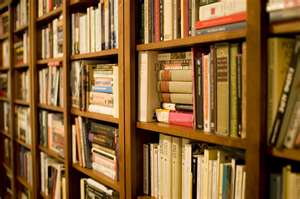
So in the absence of any new reading and blogging material, I decided to do what I'm always telling my students to do: get back to the basics. For me, the basics are my favorite authors, particularly the ones I've been reading since I was a pre-teen, the ones who inspired me to keep reading, and eventually to start writing. The basics are also the books I keep physical copies of on my bookshelf. As I've said, I'm big fan of the library and used bookstores, and now of the Kindle, so I'm pretty selective with the books I actually pay full price for. Once on my shelves, I treat them respectfully, shelving them by category and then alphabetically, making sure each one stands straight and tall, with no creased corners. I keep my favorite books on the shelves in my office, the ones for show on the shelf in the living room (beautifully crafted by my father-in-law) and the old textbooks and studies on the shelf in the finished basement. (Yes, my house has three large bookshelves and a few small ones. And there's still spillover).
But when I really, really want to go back to the basics, there's no better place to look than the Top Shelf.
The Top Shelf is reserved for the books that are closest to my heart. They are the ones that I would save in a fire, if I had time to save books. They are the ones that I want to preserve for eternity, to read and pass along to my children and grandchildren. Of all the books I read and love, they are my longest-term relationships.
Many of these will not surprise you, because I've blogged about them before, and of course, the authors are on my favorites list.
1. The complete Harry Potter series, all in hardcover, except Sorcerer's Stone, which was given to me by my friend Lisa, demanding that I read it (I guess I owe her a big thank you). Prisoner of Azkaban has a rip in the cover, because that was the only copy left in the store the afternoon I just had to buy it at Stop and Shop, right after I'd finished Chamber of Secrets. Order of the Phoenix is a bit mangled from being disrespectfully shoved into my too-small apartment mail box by my postman. I retrieved it after coming home from a friend's wedding. I stood in the parking lot at midnight, trying to pry my book free so I could go upstairs and read until dawn. I eventually had to cut the Amazon packaging away from the book with a knife before I could liberate it. But all of these battle scars are priceless, because they show my love for Harry and J.K. Rowling.
2. All of the Agatha Christie books I own, with And Then There Were None on top and Murder on the Orient Express right underneath.
3. The Lord of the Rings trilogy. I'm actually surprised right now that those are on the top shelf. Add them to Harry Potter and it looks like I'm kind of a sci-fi/ fantasy geek, but in reality, I read those genres very rarely. I do treasure The Lord of the Rings, though, because- well, who doesn't?
4. I used to have all of my books by L.M. Montgomery, including the entire Anne of Green Gables series and all of her collections of short stories. But alas, I ran out of room on the top shelf, and since my priority was keeping the collection together, I moved the whole lot to a lower level.
5. All of my Jane Austen books.
6. This one my surprise you: an American history textbook from the 1860s. I found it in a large used bookstore up in Northern New York. The view of American history from that time period is incredibly racist and narrow-minded, but I'm proud to own it as a true artifact of the culture and politics of an earlier time.
So which book will I take from my top shelf, you ask? Which book shall I choose to renew my reading pleasure? I've decided on Pride and Prejudice by Jane Austen. It lays everything out on the table for my reading pleasure: a strong and spunky heroine; a handsome, not-so-dashing hero; insane family dynamics; scandals; comedy; beautiful landscapes; English mannerisms. It's really the perfect book. If you haven't ever read Pride and Prejudice, you need to. Whatever your gender, character or reading preference, you will find something to enjoy in it; it has something for everyone. But keep your hands off my copy. It belongs on my top shelf.
Subscribe to:
Posts (Atom)