I love good food. I love good writing. Therefore, I adore good food writing.
Last week in my creative writing class, the professor passed around a short story by Jhumpa Lahiri, author of The Namesake and Unaccustomed Earth (both of which are on my to-read list). The story was called "Indian Takeout" and it described the passage of Lahiri's family's best-loved native foods from India to New Jersey in a silk-lined trunk. The discussion that arose after the story was read focused around the author's description of the foods and spices, the tastes and aromas. It was a story for all of the senses, but especially for the taste buds.
Writing about food captures my attention the way no other description does. An author can describe a setting so beautifully that I can see it before me, make me sniff at the air for the aromas in the scene, direct my ears to hear a sound that's nowhere near me, and force my fingertips to feel what the character touches beneath hers. All of these abilities are the mark of a great descriptive writer, and all are what make entering the world of a well-written book more visceral and more completely encompassing even than a 3D movie. But none of these can compare to a writer who can make you taste. Feeling, hearing, seeing and smelling- those are all outward sensations. Taste is entirely an inner sensation. When you taste, you absorb the sensation into yourself. Taste nourishes the soul in the most intimate way. Making a person taste something through mere words is magic.
I tend to remember books about food very well, even if the characters or story aren't compelling. There's a book that I've read twice, about a woman cake-maker who owns a bakery in Seattle. She finds herself in a rut with her baking creativity, and decides to go to Japan to study with a baker master. I have no idea what the name of this book is. I don't remember what the main character's name is, or what the other characters were doing in the story, or anything about the bakery or Japan. But I do remember those cakes. I remember tasting them as they were described: carrot cake with thick cream cheese frosting; pecan spice cake; deep, velvety chocolate ganache. I'd love to read that book again, just to experience those cakes again.
(If anyone knows the book I'm describing- though I doubt anyone will- please tell me what the title is!)
Similarly, I read a light, fluffy book recently, about a girl who flees Texas for the safety of her estranged grandmother's Manhattan penthouse after a scandal involving her sorority and her fiance. I thought the main character was vapid and ditzy, and the grandmother was bland and boring, but the tie that bound them together was the fact that they both baked cupcakes. Oh, the recipes, oh, the varieties! It was just like the book whose name I can't remember. In fact, it was exactly like that book, because I don't remember the title of this one either. But no matter. The cakes and cupcakes are glued to my taste buds, even if my brain couldn't hold on to the names.
One of my favorite pieces of food writing is the short story "The Three Fat Women of Antibes" by W. Somerset Maugham. I've owned Volume 1 of his collected short stories since I was ten, and it's survived many moves and used bookstore purges solely because of this story. The story is about three large women, Beatrice, Frank and Arrow, who go on a dieting "cure" together and subsequently rent a house in Antibes to encourage each other in their weight loss habits. They get on very well without alcohol, bread and dessert until Frank's cousin Lena comes to visit. Lena is thin and has been told by her doctor that she needs nourishment. The cook at the house makes wonderful meals for her: "macaroni sizzling with cheese and butter... peas swimming in cream and potatoes cooked in all sorts of delicious ways." The three women find themselves at each other's throats, sick with jealousy of Lena, who can eat all she likes and not gain weight. The climax of the story finds the three women at a cafe on the water, competing with each other to engorge themselves with indulgences, such as croissants with chocolate, hot rolls and cream, fried potatoes, and martinis. They "crunched the delicious crisp bread voluptuously... They did not speak. What they were about was much too serious. They ate with solemn, ecstatic fervor."
Anyone hungry? I think I need to make myself a snack. I hope I have fresh French bread, English cream and frosted cupcakes in my kitchen.
Tuesday, November 1, 2011

Wednesday, October 26, 2011
The Turn-Off
What makes you stop reading?

I'm not talking about picking up a book while browsing in a bookstore or library, and reading a line or two to decide if you'll take it. That's part of the process of choosing books, and there's always a chance that you'll pass over a book that you'd actually enjoy. No, I'm talking about choosing a book, taking it home, and sitting down to read it, only to become frustrated, disgusted or just plain turned off.
I make an effort with books. Sometimes I'll even finish a book that continues to evoke all the above emotions, just because there's a tiny thread of the plot that I'm a tiny bit interested in. (And sometimes I keep reading because- I admit it- it reminds me that if bad writing can get published, maybe I have a shot to publish some decent writing someday.)
But there are times that I slam a book closed, toss the bookmark away in disgust, and return it to the shelf unread. Here are the ways that I get turned off:
1. Plain old poor writing. I started reading a book a few days ago that actually changed from past to present to past tense again within the first page- and it wasn't because the character was remembering something "back in the day."
2. Unloveable characters. I don't mean unlikeable, because unlikeable characters can still be interesting, and I'll still want to know what happens to them. But if a writer can't make me care about the fate of even one person in the story, I'm done. It's why I watched Friends instead of Seinfeld. Are Jerry, Elaine, Kramer and George funny? Of course. Are they lovable enough characters that I care what happens to them? Nope. TV off.
3. Meandering plot and/or too much exposition. It's ok if the story is character-driven, but if it's plot-driven, just get to the point.
4. This is just me, but as I've said before, I'm not into sensationalism. Don't kill someone off on the first page just to kick-start the book, unless it's actually vital to the plot, like in The DaVinci Code. Profanity just for shock value also turns me off.
It does sometimes hurt to put a book down unfinished, but I try to remember that there are millions more books out there that I'm going to enjoy, and I don't need to settle for something that's not going to satisfy me.
What turns you off?

I'm not talking about picking up a book while browsing in a bookstore or library, and reading a line or two to decide if you'll take it. That's part of the process of choosing books, and there's always a chance that you'll pass over a book that you'd actually enjoy. No, I'm talking about choosing a book, taking it home, and sitting down to read it, only to become frustrated, disgusted or just plain turned off.
I make an effort with books. Sometimes I'll even finish a book that continues to evoke all the above emotions, just because there's a tiny thread of the plot that I'm a tiny bit interested in. (And sometimes I keep reading because- I admit it- it reminds me that if bad writing can get published, maybe I have a shot to publish some decent writing someday.)
But there are times that I slam a book closed, toss the bookmark away in disgust, and return it to the shelf unread. Here are the ways that I get turned off:
1. Plain old poor writing. I started reading a book a few days ago that actually changed from past to present to past tense again within the first page- and it wasn't because the character was remembering something "back in the day."
2. Unloveable characters. I don't mean unlikeable, because unlikeable characters can still be interesting, and I'll still want to know what happens to them. But if a writer can't make me care about the fate of even one person in the story, I'm done. It's why I watched Friends instead of Seinfeld. Are Jerry, Elaine, Kramer and George funny? Of course. Are they lovable enough characters that I care what happens to them? Nope. TV off.
3. Meandering plot and/or too much exposition. It's ok if the story is character-driven, but if it's plot-driven, just get to the point.
4. This is just me, but as I've said before, I'm not into sensationalism. Don't kill someone off on the first page just to kick-start the book, unless it's actually vital to the plot, like in The DaVinci Code. Profanity just for shock value also turns me off.
It does sometimes hurt to put a book down unfinished, but I try to remember that there are millions more books out there that I'm going to enjoy, and I don't need to settle for something that's not going to satisfy me.
What turns you off?
Sunday, October 23, 2011
On Writing
My grandmother, who was also a writer, left this book with me when she died. I know it was a favorite of hers, so I felt compelled to read it. I'm also in no position to turn down a writing advice book from one of the most popular authors of all time.


It took me awhile to get to it, because I'm not a fan of Stephen King's novels. Before you gasp in horror, let me explain! It has nothing to do with the writing quality. Frankly, the writing is too good, because the horror and gore have a great effect on me. I don't like being scared or grossed out. I'm the one who has to be pulled out of the haunted house screaming, or who makes her car-mates turn off the sound at the drive-in during "What Lies Beneath." (Yes, both of those things happened). I've always found that reading a good book can suck me in even more than movies or other forms of entertainment, so reading Carrie or The Stand would literally be my worst nightmare. I have read The Dead Zone, Needful Things, and The Green Mile. I think it was Needful Things that scared me off to the rest of King's prolific library. The Dead Zone and The Green Mile were more reality-based and character-driven, so I enjoyed those. If anyone would like to recommend others that are less horror and gore, more character-driven, I'd be open to trying them.
But I digress. On Writing is part memoir, part writing manual. Both provided interesting insight into King's writing world. In the memoir section, I enjoyed reading about his teenage self, getting into trouble at school for selling his own short stories. As he progressed into adulthood, he met and married his wife Tabitha, whom he speaks of lovingly and gratefully throughout the book. He and his wife and kids were very poor at the beginning of his career- he wrote his first several books in a laundry room- but then came Carrie, for which he was paid more than 30 times his yearly teacher's salary. King also writes about his issues with drinking and drugs, and tells the story about being hit by a car in 1997, halfway through the writing of this book.
In the writing manual, King lays out his strong opinions on how good writing is created, as well as rules to write by. This is a pretty long section, but it does have an overall theme: Writing is an excavation process. He refers to the story as a fossil waiting to be dug up. The writer, with the dawn of his idea (all hypothetical pronouns are male in this book) discovers where he thinks the fossil is buried. Over the course of writing, he finds the outlines of the fossil, then the details. The fossil emerges as it chooses, taking its own shape and form. In other words, if the writer pays close attention to his characters and the situation he has set for them, the story writes itself.
From my limited experience, I believe there is some truth to this. Some authors work this way and get great results. Some spend more time planning and plotting, and still are able to achieve great results (King disagrees with this). I think most writers fall in the middle. There are characters, there's a situation, and we might stop along the way to plan out a few plot twists in advance or get some more in-depth information on the characters, but mostly, it is an excavation process.
As a matter of fact, I decided to put this theory to the test this weekend. I'd had an idea for a short story on the back burner for awhile. I thought it was a good idea, but I hadn't gotten to the planning stage. So on Saturday morning, I sat down and just started writing it. Turned out, King was right- it did write itself. In fact, I got so much out of this little idea, I realized a few pages in that I was writing another novel, not a short story. It felt better than any writing I've done in weeks. It wasn't forced; it felt organic. It now puts me in the position of choosing which novel to finish first: the one I've been painstakingly researching and writing for months, or my newest fossil, which is about to grow into a dinosaur. I haven't decided yet, but I'm glad Stephen King inspired me to give the process a chance.
I'll leave you with a favorite quote from On Writing:
"At its most basic we are only discussing a learned skill, but do we not agree that sometimes the most basic skills can create things far beyond our expectations? We are talking about tools and carpentry, about words and style... but as we move along, you'd do well to remember that we are also talking about magic."
Magic.
Friday, October 21, 2011
The Nanny Diaries
A few years ago, I downloaded this book onto my iPod, and every once in awhile (usually in between Harry Potter books) I listen to it again.


This book seems to have some amnesic spell, because every time I finish it, I tell myself I'll never listen to it again, but somehow, a few months or years later, I see its playlist and think, "Oh, The Nanny Diaries! Let's try that again." Clearly, I have a love-hate relationship with this book, but it was only during my most recent attempt to listen that I figured out why.
Why I like The Nanny Diaries
My top reason for enjoying the book is a slightly guilty one. Like many women, I take great pleasure in reading about the lives of people who are more financially and socially advanced than I. We all love to peek into the world of designer clothes, impossible prep school standards, and outlandish parties given by self-obsessed Park Avenue housewives. I'm not sure where this pleasure comes from, but it explains the success of novels like Chasing Harry Winston, Valley of the Dolls and The Ivy Chronicles, and young adult series like Gossip Girl.
The Nanny Diaries plays on this theme brilliantly, not only by painting this world vividly, but by making all of the Park Avenue parents irredeemably villainous. Mrs. X is selfish, unthinking and distant from her own child. Mr. X is cheating on his family without so much as a guilty thought. Other mommies and daddies talk casually about firing a hardworking nanny for the offense of asking for a week off months in advance, and moan about how hectic their lives are, although none of them work or physically care for their own children. The children are the victims, and the nannies are unwilling spectators, involved in their world but with a mind removed from the chaos.
I also really enjoy the character of Greyer X, Nanny's little charge. His energy and four-year-old wisdom keep the book fresh through scene after scene of predictable actions by Mrs. X and reactions by Nan. On my recording, his voice is toned so cutely by the reader that my heart softens each time he speaks. I think it is mostly due to the reader's talents that I feel so warmly towards him.
Why I hate The Nanny Diaries
I can sum this up in one sentence (although I'm sure I'll have more to say after that sentence is over). I hate The Nanny Diaries because by the time I get halfway through the book, I want to reach inside it and strangle Nan.
Nan is the supreme pushover. When Mrs. X orders her into a huge purple Teletubby costume on Halloween, she obeys without outward question, though with much inward grumbling. When Mrs. X asks her to make a gourmet meal for Greyer and eat it in the child's bathroom because she has company, Nan makes several phone calls trying to make sure she's cooking it correctly. These are just a few examples of the amount of rope Nan allows to hang herself with. That's not what drives me crazy, though. What I don't understand is this: Why is Nan such a pushover only in that aspect of her life? In her non-work life, she can clearly stand up for herself. She routinely battles the deans of NYU for her credit standing, she handles issues with her roommate without resorting to passive-aggressive behavior, and most telling of all, she tells off a group of her crush's friends in a bar for making deurrogatory comments about nannies- and she does this without hesitation or minced words. Why, then, can't she say a simple "No" to Mrs. X?
Contradictions in character can be a wonderful thing. An oncologist who secretly smokes, a dynamic female politician who can't fall asleep without her teddy bear- these are interesting contradictions that, if examined properly, can reveal deep insight into the character. But Nan's dual personality in her work and home lives is never explained. She's desperate to keep the job, but why? She's nannied before, and will do so again. She got the job easily- as an English-speaking child development major, she's in demand. Other than an attachment to Greyer, which I think can be overridden by her hatred of Mrs. X, what does she have to gain by being a doormat, when that's clearly not her personality? This is what makes me want to strangle her.
The other issue I have is with the name "Nanny." The authors, Emma McLaughlin and Nicola Kraus, wanted to make the point that Nanny represents all nannies, and that Mrs. X represents all Upper East Side employers. But I think Nanny's character is too disjointed for her to be considered an "everywoman," and Mrs. X's character is too one-sided to be real. Everyone has some redeeming quality, even rich mothers. McLaughlin and Kraus, who were burned by many an Upper East Side employer themselves, didn't choose to show that.
Now that I've explored both sides of the coin, the question is: will my iPod recording live to hear another day? Will I pick up The Nanny Diaries again at a later date, and discover all that I both like and hate about it all over again? I'm pretty sure the answer to that is yes.
My apologies to Future Leanne.
Tuesday, October 18, 2011
In Her Shoes
True to my word, after being pleasantly surprised by Jennifer Weiner's writing in Then Came You, I went back to try some of her books that I had once rejected. This weekend, when I was packing for a girl's weekend away, I threw In Her Shoes into my bag. Appropriately, it's a novel about female relationships.


Once again, I was pleasantly surprised. I may or may not have read this book when it came out several years ago, but if I did I certainly didn't like it, because I've been carrying around a negative impression of Jennifer Weiner for years. I truly have no idea where this disdain came from. Maybe someone gave me aversion therapy without my knowing it. Either way, I'm mending my missteps now.
I would have a hard time reviewing this book without tying it to the movie it was made into in 2005, with Cameron Diaz and Toni Collette as sisters Maggie and Rose Feller, respectively. I usually try to read the adapted book before I see the movie, because I want to be able to form my own images, but in this case I'd already seen the movie more than once and couldn't get Diaz and Collette out of my head. Fortunately, unlike many movie adaptions, In Her Shoes stayed true to the story and was acted excellently, so I didn't have any trouble meshing the book and movie versions in my head.
Rose and Maggie are sisters with the same shoe size, but their resemblance and connection ends there. Rose is the steady, organized, somewhat boring and slightly overweight older sister; Maggie is the hard-drinking, street-wise, seductive and shiftless younger sister. The book begins with their interactions as roommates. Rose is trying to get Maggie employed and out of her apartment, and Maggie is still trying to break into stardom while slipping money out of Rose's wallet and shoes out of her closet. Tensions rise until Maggie does something despicable and Rose kicks her out. The middle of the novel takes them each on separate journeys. For Maggie, it's a journey of knowledge and self-discovery that leads her from a sleeping bag in a Princeton library to the retirement community in Florida where their long estranged grandmother Ella lives. For Rose, it's a time of letting go of herself and creating a new life, which eventually leads her to an engagement to a Simon, a food-loving fellow lawyer who is devoted to Rose. The end of the novel finds Rose seeking Maggie and Ella in Florida, and seeing how Maggie has changed from wayward drunk to responsible business owner and poetry lover. All are united at Rose's wedding, where Maggie makes a final attempt to completely redeem herself to her sister.
As the older half of a close sister relationship (though with much less conflict than Rose and Maggie!) I can say that Weiner writes sisters very well. She captures all of the dynamics, encompassing rivalry, jealousy, shared memory and fierce protectiveness. The two main characters were both complex and able to sustain a very organic, yet very dramatic change throughout the book. Their separate relationships with their deceased bipolar mother, withdrawn father, and overbearing stepmother were also written well.
There were a few loose ends in the book- the engagement between Rose and Simon in particular happened very quickly, and a strange relationship between Rose and Simon's grandmother's dog was revealed to be not coincidental, and yet never fully explained. The ending also felt kind of abrupt, and though the final scene was as moving as in the movie, I didn't feel there was a true reconciliation between the sisters, only a coming-to-terms sort of understanding with each other. I actually thought the movie was tighter and cleaner in that respect. All of the story lines were resolved clearly, without superfluous plot (for example, Maggie's time in Princeton was eliminated) and the themes of the movie were better defined: sisterhood, forgiveness, walking in each others' literal and figurative shoes. The book could have used a more decisive ending and some editing down, two elements that I think Jennifer Weiner improved upon in her later books.
All in all, it was a very enjoyable read, and I plan to watch the movie again soon.
To Ms. Weiner, if you're out there somewhere, I send you my sincere apologies. I have no idea what I didn't like about your books in the past. You are an excellent writer and I fully intend to read your entire body of work over the coming months. Keep 'em coming.
Sincerely, Leanne
Wednesday, October 12, 2011
A Tree Grows in Brooklyn
A few months ago, I was talking about doing research for my novel, which takes place in the early 1900s, and a friend suggested I read A Tree Grows in Brooklyn.


It's one of those books that's been on my to-read list for ages, just by virtue of its status in classic literature, but I had no idea that it was set in the same time period AND the same metropolitan area that I am currently researching. So I eagerly picked it up from the library and started reading right away. Several days and 500 pages later, I was done. It's a terribly long book for the type of book it is. If I were to sum up the plot simply, I would say that one thing happens: A kid in Brooklyn grows up. The end.
Clearly, it's not the plot that makes the book so special. There's no climax, and the characters are all given an impossibly happy ending. The book is really just a long thread of events in the life of a poor family in the early 1900s. And, contrary to its title, it has nothing to do with trees, except for the obvious metaphor.
Despite all that, it's easy to see why this book has endured since its first publication in 1943. The characters are both complex and endearing. From the first page, I wanted to reach into the book and hug Francie. I wanted to hang out on street corners with Neeley, listen to Johnny's drunken singing, and shake Katie hard to make her see what a wonderful daughter she has. It was easy to root for these characters, because every one of them was spunky, spirited and resilient. It was fun to read about their adventures together, because they made such an interesting team.
This is a classic rags-to-riches, pull-yourself-up-by-your-bootstraps, American dream story. The conflict between man and poverty that underlines the book hits home for our current times, although I fear that Francie and her family would have had even fewer opportunities to better their situation in today's economic climate.
Here's the main thing that makes this book a classic: The writing is simply steeped in truth. The honesty pouring from Betty Smith's pen is greater than any other author I can think of. This is not to say that I now know exactly what it was like to be a very poor little girl living in Brooklyn at the turn of the century. Rather, through the girl's eyes, I know what it means to be human, in any time period, in any city, in any situation. You'll see what I mean if you read the book. Just to give you a taste, though, I've included two of my favorite excerpts below. The first is thought by Francie, the daughter; the second by Katie, the mother.
"Oh, magic hour when a child first knows it can read printed words! For quite awhile, Francie had been spelling out letters, sounding them and then putting the sounds together to mean a word. But one day, she looked at a page and the word "mouse" had instantaneous meaning. She looked at the word, and the picture of a gray mouse scampered through her mind. She looked further and when she saw "horse," she heard him pawing the ground and saw the sun glint on his glossy coat. The word "running" hit her suddenly and she breathed hard as though running herself. The barrier between the individual sound of each letter and the whole meaning of the word was removed and the printed word meant a thing at one quick glance. She read a few pages rapidly and almost became ill with excitement. She wanted to shout it out. She could read! She could read!"
"Katie heard the story. "It's come at last," she thought, "the time when you can no longer stand between your children and heartache. When there wasn't enough food in the house you pretended that you weren't hungry so they could have more. In the cold of a winter's night you got up and put your blanket on their bed so they wouldn't be cold. You'd kill anyone who tried to harm them... Then one sunny day, they walk out in all innocence and they walk right into the grief that you'd give your life to spare them."
I don't think writing gets more transparently truthful than that.
Monday, October 10, 2011
Desert Island
If you were trapped on a deserted island, what five books would you want to have on the island with you?

Keep in mind that the words in these books may have to sustain you for the rest of your life. You'd want a variety of genres to stave off boredom as long as possible, and meaningful themes or topics that you could contemplate during your long hours sweating in the sun. You may also want the books to contain some humor or uplifting poetry to keep your spirits alive while you are subsisting on grubs and possibly conversing with painted volleyballs.
Here are my five books, and why I chose them:
1. The Complete Works of Shakespeare by William Shakespeare. This one should be obvious. It's incredibly long and diverse. I could spend days, even weeks, acting out the parts in all of the plays. I'm sure I would find great relief in pretending to be Puck making mischief in my own wilderness, or Ophelia contemplating death via a convenient body of water. In addition, the beauty of the sonnets would surely provide solace, and I could devote time to memorizing them, so that if I ever got off the island, I could impress people at parties.
2. Anne of Green Gables by L.M. Montgomery. This was the book that was the tipping point to my love of reading, and I return to it every couple of years. I don't think I'd want to live in a world without easy access to Anne's sunny optimism, Marilla's sarcasm, Matthew's quiet love, and Gilbert's steadfast faithfulness.
3. Harry Potter and the Deathly Hallows by J.K. Rowling. Just like with Anne, I wouldn't want to live in a world without Harry, Hermione and Ron. I could read about their adventures over and over again, and never be tired of them. If I could, I'd take the whole series, but I think that would be cheating, so I'll choose Rowling's masterpiece, the ultimate climactic work in the world of book series.
4. And Then There Were None by Agatha Christie. I debated about this one, because it's much shorter than the rest, and is a very fast read. But I wouldn't want to leave my favorite mystery behind. It's suspenseful and powerful, and has the added drama of actually taking place on an island. Fortunately, since my island is deserted, it's pretty unlikely that I'll be the last of ten killed. Unless I start hallucinating. Hmm.
5. For my last book, I'd choose either Outliers by Malcolm Gladwell, or The Fountainhead by Ayn Rand. While these books are complete opposites in the literary sense, they would both serve the purpose of buffeting my senses of perseverance, motivation, and self-worth. Perhaps they would even spur me on to creating a device to get me off the island. The Fountainhead would have the additional merit of reminding me of the worthless, unintelligent peons I left behind. I might even go so far as to be grateful for my exile.
I'm quite pleased with this list. I think I've managed to capture the variety, meaning, humor and poetry required to satisfy my reading needs on this mythical island. I've even made sure that at least two of the books are quite hefty, and could be used not only for entertainment, but also for throwing at the heads of my prey.
What are your five desert island books?

Keep in mind that the words in these books may have to sustain you for the rest of your life. You'd want a variety of genres to stave off boredom as long as possible, and meaningful themes or topics that you could contemplate during your long hours sweating in the sun. You may also want the books to contain some humor or uplifting poetry to keep your spirits alive while you are subsisting on grubs and possibly conversing with painted volleyballs.
Here are my five books, and why I chose them:
1. The Complete Works of Shakespeare by William Shakespeare. This one should be obvious. It's incredibly long and diverse. I could spend days, even weeks, acting out the parts in all of the plays. I'm sure I would find great relief in pretending to be Puck making mischief in my own wilderness, or Ophelia contemplating death via a convenient body of water. In addition, the beauty of the sonnets would surely provide solace, and I could devote time to memorizing them, so that if I ever got off the island, I could impress people at parties.
2. Anne of Green Gables by L.M. Montgomery. This was the book that was the tipping point to my love of reading, and I return to it every couple of years. I don't think I'd want to live in a world without easy access to Anne's sunny optimism, Marilla's sarcasm, Matthew's quiet love, and Gilbert's steadfast faithfulness.
3. Harry Potter and the Deathly Hallows by J.K. Rowling. Just like with Anne, I wouldn't want to live in a world without Harry, Hermione and Ron. I could read about their adventures over and over again, and never be tired of them. If I could, I'd take the whole series, but I think that would be cheating, so I'll choose Rowling's masterpiece, the ultimate climactic work in the world of book series.
4. And Then There Were None by Agatha Christie. I debated about this one, because it's much shorter than the rest, and is a very fast read. But I wouldn't want to leave my favorite mystery behind. It's suspenseful and powerful, and has the added drama of actually taking place on an island. Fortunately, since my island is deserted, it's pretty unlikely that I'll be the last of ten killed. Unless I start hallucinating. Hmm.
5. For my last book, I'd choose either Outliers by Malcolm Gladwell, or The Fountainhead by Ayn Rand. While these books are complete opposites in the literary sense, they would both serve the purpose of buffeting my senses of perseverance, motivation, and self-worth. Perhaps they would even spur me on to creating a device to get me off the island. The Fountainhead would have the additional merit of reminding me of the worthless, unintelligent peons I left behind. I might even go so far as to be grateful for my exile.
I'm quite pleased with this list. I think I've managed to capture the variety, meaning, humor and poetry required to satisfy my reading needs on this mythical island. I've even made sure that at least two of the books are quite hefty, and could be used not only for entertainment, but also for throwing at the heads of my prey.
What are your five desert island books?
Sunday, October 9, 2011
The Time Traveler's Wife
I'm glad everyone enjoyed the "Much Ado about Shakespeare" post so much! It got far more hits and re-postings than any other post thus far. Thanks for your support!
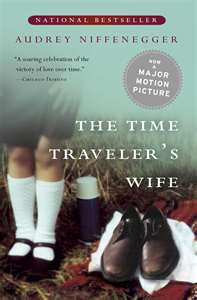
Today's book is The Time Traveler's Wife by Audrey Niffenegger.

I missed the bandwagon on this book. It was very popular a few years ago, and I remember picking it up, reading the first page or so, and wondering what all the fuss was about. I guess it must have just been bad timing for me and this book, because I really enjoyed it after I finally got around to it again. I listened to it on audiobook, which I usually reserve for either thrilling or light tales, not for literary fiction. I've found that the way literary fiction is read often compromises the my interpretation of the story. But after listening to a few chapters of this book, I realized this wouldn't be the case. The readers (one for Henry, one for Clare) gave a solid reading, with just enough inflection and not too much acting.
The premise of this book is incredibly original. Henry DeTamble has a genetic condition that causes him to spontaneously travel through time. One moment he's living his ordinary life as a librarian in Chicago, and the next moment he's popped out in a new location on an unspecified day. He arrives both naked and nauseous. Sometimes these time-travels take him to random places, but often he visits his past life or his wife's past life. When Clare and Henry first meet during her lifetime, she is only 6, but he is much older. He visits her often during her childhood and teenage years, first as a friend, and later, as Clare's hormonal attraction kicks in, as a lover. When Clare is 18, she sees "future Henry" for the last time in her childhood. Two years later they meet for the first time in real time when Henry is 28. He does not know her and she spends their first date telling him about all of her experiences with his future selves.
Clare and Henry's life together is peppered with strange disappearances and re-appearances. Clare is constantly frightened that Henry will be hurt or killed during one of his time-travels. Henry seeks help from a geneticist, Dr. Kendrick, who cannot cure his condition but does eventually help the pair to have a child after several painful miscarriages. Sometimes Henry visits the future. In one moving scene, he meets his daughter Alba at age 10, who in his own lifetime is still in his wife's womb. He is overjoyed at her beauty, intelligence, musical talent and self-possessed nature, but she reveals to him a terrible secret about his own future which he must carry back to his present.
I have read that Audrey Niffenegger (who incidentally is an accomplished artist as well as a writer) wrote this book after a failed relationship, as a metaphor for broken communication and failure in all relationships. But if that was her intention, I don't think she succeeded. Despite the sometimes insurmountable difficulties caused by Henry's condition, the relationship between Clare and Henry is very beautiful. They are trusting, loving, and very supportive of each other. This book has a lot of heart, and it never travels away from Clare and Henry. The true genius of the book is not the science-fiction aspect of it, but the romance and heartache of it.
I do have one criticism of the book, namely that though Henry travels often to the 1960s, 70s, 80s and 90s, the reader never feels grounded in those time periods. Niffenegger is very skilled at placing Henry on the map of his own life, but not necessarily at providing the detail that would familiarize the reader with the time. I would have loved little details like Henry noting how a phone ring sounded, the progressive size of fast-food drinks, or the fashion of the day.
The funny thing is, I still haven't actually finished this book. I loaded all of the audiobook onto my iPod, and must have missed the last disc, because it abruptly stopped in the middle of a climactic scene. I'm planning to read the last few chapters in the library sometime this week, and although I don't expect any surprises or happy endings based on the last thing I read, I am looking forward to one more new experience with Henry and Clare. I may even watch the movie at some point, because I'm a fan of Rachel McAdams, but I have heard that it's a disappointing adaptation, so I may also decide to skip it and preserve my own picture of these characters in my imagination.
Today's book is The Time Traveler's Wife by Audrey Niffenegger.
I missed the bandwagon on this book. It was very popular a few years ago, and I remember picking it up, reading the first page or so, and wondering what all the fuss was about. I guess it must have just been bad timing for me and this book, because I really enjoyed it after I finally got around to it again. I listened to it on audiobook, which I usually reserve for either thrilling or light tales, not for literary fiction. I've found that the way literary fiction is read often compromises the my interpretation of the story. But after listening to a few chapters of this book, I realized this wouldn't be the case. The readers (one for Henry, one for Clare) gave a solid reading, with just enough inflection and not too much acting.
The premise of this book is incredibly original. Henry DeTamble has a genetic condition that causes him to spontaneously travel through time. One moment he's living his ordinary life as a librarian in Chicago, and the next moment he's popped out in a new location on an unspecified day. He arrives both naked and nauseous. Sometimes these time-travels take him to random places, but often he visits his past life or his wife's past life. When Clare and Henry first meet during her lifetime, she is only 6, but he is much older. He visits her often during her childhood and teenage years, first as a friend, and later, as Clare's hormonal attraction kicks in, as a lover. When Clare is 18, she sees "future Henry" for the last time in her childhood. Two years later they meet for the first time in real time when Henry is 28. He does not know her and she spends their first date telling him about all of her experiences with his future selves.
Clare and Henry's life together is peppered with strange disappearances and re-appearances. Clare is constantly frightened that Henry will be hurt or killed during one of his time-travels. Henry seeks help from a geneticist, Dr. Kendrick, who cannot cure his condition but does eventually help the pair to have a child after several painful miscarriages. Sometimes Henry visits the future. In one moving scene, he meets his daughter Alba at age 10, who in his own lifetime is still in his wife's womb. He is overjoyed at her beauty, intelligence, musical talent and self-possessed nature, but she reveals to him a terrible secret about his own future which he must carry back to his present.
I have read that Audrey Niffenegger (who incidentally is an accomplished artist as well as a writer) wrote this book after a failed relationship, as a metaphor for broken communication and failure in all relationships. But if that was her intention, I don't think she succeeded. Despite the sometimes insurmountable difficulties caused by Henry's condition, the relationship between Clare and Henry is very beautiful. They are trusting, loving, and very supportive of each other. This book has a lot of heart, and it never travels away from Clare and Henry. The true genius of the book is not the science-fiction aspect of it, but the romance and heartache of it.
I do have one criticism of the book, namely that though Henry travels often to the 1960s, 70s, 80s and 90s, the reader never feels grounded in those time periods. Niffenegger is very skilled at placing Henry on the map of his own life, but not necessarily at providing the detail that would familiarize the reader with the time. I would have loved little details like Henry noting how a phone ring sounded, the progressive size of fast-food drinks, or the fashion of the day.
The funny thing is, I still haven't actually finished this book. I loaded all of the audiobook onto my iPod, and must have missed the last disc, because it abruptly stopped in the middle of a climactic scene. I'm planning to read the last few chapters in the library sometime this week, and although I don't expect any surprises or happy endings based on the last thing I read, I am looking forward to one more new experience with Henry and Clare. I may even watch the movie at some point, because I'm a fan of Rachel McAdams, but I have heard that it's a disappointing adaptation, so I may also decide to skip it and preserve my own picture of these characters in my imagination.
Subscribe to:
Posts (Atom)