
Tuesday, November 15, 2011
1,000
We've hit a milestone with this blog: 1,000 hits! It's a modest number, spread over about 80 days and 29 posts. But I'm proud to have a regular readership with this blog, however small. Hopefully it will continue to grow. Thank you, readers!

Monday, November 14, 2011
Always Something There
On Saturday night I had nothing major to do, but I didn't want to sit down and read anything serious or heavy. After spending about an hour flicking through movies on demand and concluding that there are enough good movies out there to fill Jennifer Aniston's big toenail, I decided to read something silly and girly. Here's what I chose:


You might wonder why I had this book in my house at all, because I'm not really a fan of Beth Harbison. I did read Shoe Addicts Anonymous and Secrets of a Shoe Addict (the latter was disappointing, because I was looking for a sequel and ended up with three new main characters- and not a whole lot of shoes). My opinion of Beth Harbison is that she knows how to spin an interesting plot and writes reasonably deep characters. However, I find her writing style lacking. More on that later. At any rate, the reason I had the book in my house is because I'm kind of a sucker for a pastel cover. They attract my attention, which I'm sure was the publisher's intention.
The plot of this book is pretty straightforward. Erin, who is in her late thirties with a teenage daughter, receives a marriage proposal from her boyfriend Rick. Rick seems to have it all: he's smart, handsome, successful, and most importantly, he's a surrogate father to Erin's daughter Camilla. And yet when Rick says those magic words, will you marry me, the first thing that flashes across Erin's brain is Nate. Nate is the name of her ex-boyfriend, the guy she dated for two years in high school, her first and most powerful love. She hasn't spoken to Nate in years, and yet now that Rick has proposed, he's all she can think about. Naturally, he pops back into her life, and though now married to her ex-friend, seems to be feeling the same way toward Erin. The story is told through Erin's first person point of view in the present, interspersed with flashbacks to high school in third person point of view.
It's that tired, old, magic formula: Boy meets girl, boy gets girl, boy loses girl, and (many years later) girl and boy find each other again. It's the stuff of romantic comedies, and indeed, I wouldn't be surprised if this book were made into a movie, starring, say, Katie Holmes as Erin (she's pretty, has chemistry with her co-stars, and is very capable of playing the girl-who-can't-decide: Dawson's Creek, anyone?). However, there are some interesting twists, and the flashback material is engaging enough that the weakness of the plot isn't noticeable while reading. It was only afterward that I realized how simplistic it was.
As I said earlier, I find Beth Harbison's writing style lacking. She's a very plain writer. She uses all those descriptions that creative writing teachers hate: "great" "pretty" "nice." She rarely describes a scene or a person so that the reader can truly see it. Some of her sentences are so awkward or cliche that they actually make me wince as I'm reading. For example: "We all knew she was doing it to mark her territory as surely as if she'd peed on him." Sentences like that make me wonder why she's even published.
There is one thing that Harbison does well in this book, though. She's able to truly capture the passion and utter vulnerability of a first love, and the feeling, after the breakup, as if a piece of the self is lost forever. I really felt like she hit the nail on the head with every scene between Erin and Nate: Erin's youthful passion, Nate's distanced emotion, their mutual willingness to take leaps with each other over and over again, which made the ending of the book realistic (which it would not have been if Harbison hadn't described the relationship so well).
I'm not necessarily recommending this book, and I don't expect to pick up another Beth Harbison book again, pastel or otherwise. But if you remember your first love, if you want to revisit those feelings vicariously, this book will take you on that journey.
Friday, November 11, 2011
Dream When You're Feeling Blue
I had planned to post tonight about another book entirely, but the observance of Veteran's day gave me a new idea. More specifically, I was inspired by my husband's big band, currently performing in a 1940s- themed radio broadcast at the FDR home in Hyde Park, NY. The show includes 40s-era big band music, snippets of WWII news broadcasts, and stories from Veterans and children of Veterans. I'm listening to the radio station right now, online at http://www.soundoflife.org/radio/. I'm not sure if it will be available after the broadcast ends at 9:00 tonight, but if it is, give it a listen. Yes, I'm biased, but the band is fantastic, and the news snippets are hauntingly fascinating.
The music instantly reminded me of this book.

It's actually been a long time since I've read it, but it's one of those books that has stuck with me without my quite knowing why. It's about life on the home front in Chicago during WWII. The story centers on an Irish Catholic family with three teenage girls, the Heaney sisters: Kitty, Louise and Tish. At the start of the book, the Heaney girls are lighthearted, flirtatious and vain. As the war progresses, they each begin to take the war and the soldiers to their hearts. Patriotic and loyal to a fault, the three support the war effort by taking jobs in airplane factories; making do with small food rations and faux silk stockings; organizing and attending endless USO dances and benefits; and most of all, sitting at the kitchen table every night, writing letters to their boys overseas. Kitty's letters from her boyfriend Julian, who she had expected to propose to her before shipping out, seem dry and lacking emotion, and lead Kitty to seek understanding about the war elsewhere. Louise's correspondences with fiance Michael are sensitive, loving and poetic, but neither hints at the fears they both carry, or the damaging secret Louise also carries. Tish gayly writes to several men, content to do her duty by keeping her letters light, funny and flirtatious. Meanwhile, mother Margaret watches over her girls, a sharp eye and witty retort always at the ready. As the story progresses, each sister becomes more aware of her feelings about love, friendship, loyalty and family, and in the end, each has created a new dream for herself and her sweetheart.
Elizabeth Berg is an author I truly admire (in fact, I really should add her to my "favorites" list). She has a style of writing that's both candid and poetic. Though generally not a historical fiction writer, she obviously did her research on this book, and treated the time period with respect, realism and plenty of detail. I do think there's a sepia-toned romanticism about parts of this book that may disturb some who lived during these times. But then again, all difficult time periods find relief in the simple happiness of things such as letters, dancing and pin-curls, and as I didn't live through WWII myself, I'm not qualified to judge whether these small joys are over-emphasized.
Altogether, this is a beautiful book with wonderful characters and setting. Even those who don't usually read historical fiction will find something to enjoy here.
And finally, if you're finding the song "Dream (When You're Feeling Blue)" stuck in your head, as I am, here's a little relief:
The music instantly reminded me of this book.
It's actually been a long time since I've read it, but it's one of those books that has stuck with me without my quite knowing why. It's about life on the home front in Chicago during WWII. The story centers on an Irish Catholic family with three teenage girls, the Heaney sisters: Kitty, Louise and Tish. At the start of the book, the Heaney girls are lighthearted, flirtatious and vain. As the war progresses, they each begin to take the war and the soldiers to their hearts. Patriotic and loyal to a fault, the three support the war effort by taking jobs in airplane factories; making do with small food rations and faux silk stockings; organizing and attending endless USO dances and benefits; and most of all, sitting at the kitchen table every night, writing letters to their boys overseas. Kitty's letters from her boyfriend Julian, who she had expected to propose to her before shipping out, seem dry and lacking emotion, and lead Kitty to seek understanding about the war elsewhere. Louise's correspondences with fiance Michael are sensitive, loving and poetic, but neither hints at the fears they both carry, or the damaging secret Louise also carries. Tish gayly writes to several men, content to do her duty by keeping her letters light, funny and flirtatious. Meanwhile, mother Margaret watches over her girls, a sharp eye and witty retort always at the ready. As the story progresses, each sister becomes more aware of her feelings about love, friendship, loyalty and family, and in the end, each has created a new dream for herself and her sweetheart.
Elizabeth Berg is an author I truly admire (in fact, I really should add her to my "favorites" list). She has a style of writing that's both candid and poetic. Though generally not a historical fiction writer, she obviously did her research on this book, and treated the time period with respect, realism and plenty of detail. I do think there's a sepia-toned romanticism about parts of this book that may disturb some who lived during these times. But then again, all difficult time periods find relief in the simple happiness of things such as letters, dancing and pin-curls, and as I didn't live through WWII myself, I'm not qualified to judge whether these small joys are over-emphasized.
Altogether, this is a beautiful book with wonderful characters and setting. Even those who don't usually read historical fiction will find something to enjoy here.
And finally, if you're finding the song "Dream (When You're Feeling Blue)" stuck in your head, as I am, here's a little relief:
Tuesday, November 8, 2011
The Leftovers
My reading drought is over: I finally found and finished a new book!

I've always liked Tom Perrotta's books. He has a unique take on families and relationships, and his plots are original. This one was a lot further out there than most: I'd describe it as sci-fi meets family drama meets drinking the Kool-Aid.
When the book opens, the world has just been devastated by an unexplained phenomenon. Millions of people, husbands and wives, brothers and sisters, bartenders and frat house brothers and secret girlfriends, have simply vanished, popped out of being. Many believe that the disappearance of all of these souls is the Rapture, and the rest of the world has simply been left behind. The religious and pious among them are angry at being passed over. Many others don't care to assign a reason to the disappearance. They are only able to grieve for the loss of their loved ones. The world is in chaos.
In the midst of the confusion arise several cult groups to address the needs of the leftovers. Some promise that hugging will transfer the pain of loss from one to another. Others encourage people to travel barefoot through life, experiencing as much pleasure as they can before another mass vanishment occurs. Members of a group called the Guilty Remnant dress all in white, take vows of silence, smoke cigarettes and walk in pairs through the streets. They watch and follow their fellow citizens, their eyes a judgement of mistakes and misdeeds, their appearance a reminder that everyone will vanish someday.
This is the world that the Garvey family inhabits. Before the Sudden Departure, the Garveys were a normal suburban family, comfortable and happy. Laurie was a stay-at home mom; Kevin owned a successful business, which he was preparing to sell and head for early retirement; Jill was a straight-A junior in high school; and Tom had just started his first semester at Syracuse. When the dust of the departure settles, Laurie has abandoned her family to join the Guilty Remnant, where she forms a strange relationship with a young woman named Meg; Jill has befriended Aimee, a party-loving girl who crashes at the Garvey house and leads Jill astray; Tom has begun serving Holy Wayne, the founder of the Healing Hug movement; and Kevin is left with a big house, a daughter he no longer understands, and a spare teenager. Kevin decides to run for mayor of the grieving town, and helps get it back on its feet. On the way, he starts a relationship with Nora Durst, who lost her entire family in the Sudden Departure, but Nora finds it nearly impossible to move on with her life.
I won't give away the rest of the book, but I will tell you that it's not really about people vanishing, or being a leftover, or any religious interpretation of the Rapture. It's about a family and how they each deal with an unthinkable disaster in ways that tear some apart and force some together, and about a world gone mad with grief and confusion. The Sudden Disappearance is never explained. The book is only about the aftermath of something neither the characters nor the reader (nor the author, probably) understand.
Now reviewing my synopsis above, I realize how crazy it all sounds. I wonder how Tom Perrotta pitched the book to his editor. "Yeah, it's about a family in a post-Rapture-esque world, and the mother and son join different cults, and I'm never going to explain what the Sudden Disappearance is or why it happened. Hope that's cool."
I'm glad the editor bought it. You should too!

I've always liked Tom Perrotta's books. He has a unique take on families and relationships, and his plots are original. This one was a lot further out there than most: I'd describe it as sci-fi meets family drama meets drinking the Kool-Aid.
When the book opens, the world has just been devastated by an unexplained phenomenon. Millions of people, husbands and wives, brothers and sisters, bartenders and frat house brothers and secret girlfriends, have simply vanished, popped out of being. Many believe that the disappearance of all of these souls is the Rapture, and the rest of the world has simply been left behind. The religious and pious among them are angry at being passed over. Many others don't care to assign a reason to the disappearance. They are only able to grieve for the loss of their loved ones. The world is in chaos.
In the midst of the confusion arise several cult groups to address the needs of the leftovers. Some promise that hugging will transfer the pain of loss from one to another. Others encourage people to travel barefoot through life, experiencing as much pleasure as they can before another mass vanishment occurs. Members of a group called the Guilty Remnant dress all in white, take vows of silence, smoke cigarettes and walk in pairs through the streets. They watch and follow their fellow citizens, their eyes a judgement of mistakes and misdeeds, their appearance a reminder that everyone will vanish someday.
This is the world that the Garvey family inhabits. Before the Sudden Departure, the Garveys were a normal suburban family, comfortable and happy. Laurie was a stay-at home mom; Kevin owned a successful business, which he was preparing to sell and head for early retirement; Jill was a straight-A junior in high school; and Tom had just started his first semester at Syracuse. When the dust of the departure settles, Laurie has abandoned her family to join the Guilty Remnant, where she forms a strange relationship with a young woman named Meg; Jill has befriended Aimee, a party-loving girl who crashes at the Garvey house and leads Jill astray; Tom has begun serving Holy Wayne, the founder of the Healing Hug movement; and Kevin is left with a big house, a daughter he no longer understands, and a spare teenager. Kevin decides to run for mayor of the grieving town, and helps get it back on its feet. On the way, he starts a relationship with Nora Durst, who lost her entire family in the Sudden Departure, but Nora finds it nearly impossible to move on with her life.
I won't give away the rest of the book, but I will tell you that it's not really about people vanishing, or being a leftover, or any religious interpretation of the Rapture. It's about a family and how they each deal with an unthinkable disaster in ways that tear some apart and force some together, and about a world gone mad with grief and confusion. The Sudden Disappearance is never explained. The book is only about the aftermath of something neither the characters nor the reader (nor the author, probably) understand.
Now reviewing my synopsis above, I realize how crazy it all sounds. I wonder how Tom Perrotta pitched the book to his editor. "Yeah, it's about a family in a post-Rapture-esque world, and the mother and son join different cults, and I'm never going to explain what the Sudden Disappearance is or why it happened. Hope that's cool."
I'm glad the editor bought it. You should too!
Thursday, November 3, 2011
The Top Shelf
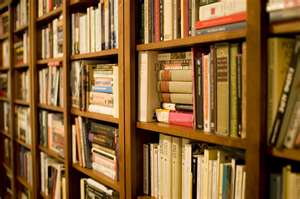
Recently, I've found myself in kind of a reading drought, which is not the best situation for someone who's committed herself to writing a blog about reading. It's been a while since I've read a book that really knocked my socks off. I'd even settle for a book that kept me awake past my bedtime. But unfortunately, the last several books I've started have gone nowhere.
During a recent library trip, I took out three audiobooks, and I had to turn off each one partway through the first CD. They were: Secrets of Eden by Chris Bohjalian (couldn't stomach the reader), The Carrie Diaries by Candace Bushnell (couldn't connect to the shallow teenage girl culture), and a completely forgettable book called Some Like it Haute (just ugh). I've also tried reading The Thirteenth Tale by Diane Setterfield (couldn't make myself care about the two main characters- see my previous post, The Turn Off) and As I Lay Dying by William Faulkner (yes, I know I'm supposed to like this book, and I haven't completely given up on it yet. I just have to read it slowly, because I can't take too much Faulkner in one sitting). To be honest, the best things I've read lately have been short stories from my creative writing class, and as wonderful as those are as a snack, I'm really craving a book to feast on.
So in the absence of any new reading and blogging material, I decided to do what I'm always telling my students to do: get back to the basics. For me, the basics are my favorite authors, particularly the ones I've been reading since I was a pre-teen, the ones who inspired me to keep reading, and eventually to start writing. The basics are also the books I keep physical copies of on my bookshelf. As I've said, I'm big fan of the library and used bookstores, and now of the Kindle, so I'm pretty selective with the books I actually pay full price for. Once on my shelves, I treat them respectfully, shelving them by category and then alphabetically, making sure each one stands straight and tall, with no creased corners. I keep my favorite books on the shelves in my office, the ones for show on the shelf in the living room (beautifully crafted by my father-in-law) and the old textbooks and studies on the shelf in the finished basement. (Yes, my house has three large bookshelves and a few small ones. And there's still spillover).
But when I really, really want to go back to the basics, there's no better place to look than the Top Shelf.
The Top Shelf is reserved for the books that are closest to my heart. They are the ones that I would save in a fire, if I had time to save books. They are the ones that I want to preserve for eternity, to read and pass along to my children and grandchildren. Of all the books I read and love, they are my longest-term relationships.
Many of these will not surprise you, because I've blogged about them before, and of course, the authors are on my favorites list.
1. The complete Harry Potter series, all in hardcover, except Sorcerer's Stone, which was given to me by my friend Lisa, demanding that I read it (I guess I owe her a big thank you). Prisoner of Azkaban has a rip in the cover, because that was the only copy left in the store the afternoon I just had to buy it at Stop and Shop, right after I'd finished Chamber of Secrets. Order of the Phoenix is a bit mangled from being disrespectfully shoved into my too-small apartment mail box by my postman. I retrieved it after coming home from a friend's wedding. I stood in the parking lot at midnight, trying to pry my book free so I could go upstairs and read until dawn. I eventually had to cut the Amazon packaging away from the book with a knife before I could liberate it. But all of these battle scars are priceless, because they show my love for Harry and J.K. Rowling.
2. All of the Agatha Christie books I own, with And Then There Were None on top and Murder on the Orient Express right underneath.
3. The Lord of the Rings trilogy. I'm actually surprised right now that those are on the top shelf. Add them to Harry Potter and it looks like I'm kind of a sci-fi/ fantasy geek, but in reality, I read those genres very rarely. I do treasure The Lord of the Rings, though, because- well, who doesn't?
4. I used to have all of my books by L.M. Montgomery, including the entire Anne of Green Gables series and all of her collections of short stories. But alas, I ran out of room on the top shelf, and since my priority was keeping the collection together, I moved the whole lot to a lower level.
5. All of my Jane Austen books.
6. This one my surprise you: an American history textbook from the 1860s. I found it in a large used bookstore up in Northern New York. The view of American history from that time period is incredibly racist and narrow-minded, but I'm proud to own it as a true artifact of the culture and politics of an earlier time.
So which book will I take from my top shelf, you ask? Which book shall I choose to renew my reading pleasure? I've decided on Pride and Prejudice by Jane Austen. It lays everything out on the table for my reading pleasure: a strong and spunky heroine; a handsome, not-so-dashing hero; insane family dynamics; scandals; comedy; beautiful landscapes; English mannerisms. It's really the perfect book. If you haven't ever read Pride and Prejudice, you need to. Whatever your gender, character or reading preference, you will find something to enjoy in it; it has something for everyone. But keep your hands off my copy. It belongs on my top shelf.
Tuesday, November 1, 2011
Taste the Words
I love good food. I love good writing. Therefore, I adore good food writing.
Last week in my creative writing class, the professor passed around a short story by Jhumpa Lahiri, author of The Namesake and Unaccustomed Earth (both of which are on my to-read list). The story was called "Indian Takeout" and it described the passage of Lahiri's family's best-loved native foods from India to New Jersey in a silk-lined trunk. The discussion that arose after the story was read focused around the author's description of the foods and spices, the tastes and aromas. It was a story for all of the senses, but especially for the taste buds.
Writing about food captures my attention the way no other description does. An author can describe a setting so beautifully that I can see it before me, make me sniff at the air for the aromas in the scene, direct my ears to hear a sound that's nowhere near me, and force my fingertips to feel what the character touches beneath hers. All of these abilities are the mark of a great descriptive writer, and all are what make entering the world of a well-written book more visceral and more completely encompassing even than a 3D movie. But none of these can compare to a writer who can make you taste. Feeling, hearing, seeing and smelling- those are all outward sensations. Taste is entirely an inner sensation. When you taste, you absorb the sensation into yourself. Taste nourishes the soul in the most intimate way. Making a person taste something through mere words is magic.
I tend to remember books about food very well, even if the characters or story aren't compelling. There's a book that I've read twice, about a woman cake-maker who owns a bakery in Seattle. She finds herself in a rut with her baking creativity, and decides to go to Japan to study with a baker master. I have no idea what the name of this book is. I don't remember what the main character's name is, or what the other characters were doing in the story, or anything about the bakery or Japan. But I do remember those cakes. I remember tasting them as they were described: carrot cake with thick cream cheese frosting; pecan spice cake; deep, velvety chocolate ganache. I'd love to read that book again, just to experience those cakes again.
(If anyone knows the book I'm describing- though I doubt anyone will- please tell me what the title is!)
Similarly, I read a light, fluffy book recently, about a girl who flees Texas for the safety of her estranged grandmother's Manhattan penthouse after a scandal involving her sorority and her fiance. I thought the main character was vapid and ditzy, and the grandmother was bland and boring, but the tie that bound them together was the fact that they both baked cupcakes. Oh, the recipes, oh, the varieties! It was just like the book whose name I can't remember. In fact, it was exactly like that book, because I don't remember the title of this one either. But no matter. The cakes and cupcakes are glued to my taste buds, even if my brain couldn't hold on to the names.
One of my favorite pieces of food writing is the short story "The Three Fat Women of Antibes" by W. Somerset Maugham. I've owned Volume 1 of his collected short stories since I was ten, and it's survived many moves and used bookstore purges solely because of this story. The story is about three large women, Beatrice, Frank and Arrow, who go on a dieting "cure" together and subsequently rent a house in Antibes to encourage each other in their weight loss habits. They get on very well without alcohol, bread and dessert until Frank's cousin Lena comes to visit. Lena is thin and has been told by her doctor that she needs nourishment. The cook at the house makes wonderful meals for her: "macaroni sizzling with cheese and butter... peas swimming in cream and potatoes cooked in all sorts of delicious ways." The three women find themselves at each other's throats, sick with jealousy of Lena, who can eat all she likes and not gain weight. The climax of the story finds the three women at a cafe on the water, competing with each other to engorge themselves with indulgences, such as croissants with chocolate, hot rolls and cream, fried potatoes, and martinis. They "crunched the delicious crisp bread voluptuously... They did not speak. What they were about was much too serious. They ate with solemn, ecstatic fervor."
Anyone hungry? I think I need to make myself a snack. I hope I have fresh French bread, English cream and frosted cupcakes in my kitchen.
Last week in my creative writing class, the professor passed around a short story by Jhumpa Lahiri, author of The Namesake and Unaccustomed Earth (both of which are on my to-read list). The story was called "Indian Takeout" and it described the passage of Lahiri's family's best-loved native foods from India to New Jersey in a silk-lined trunk. The discussion that arose after the story was read focused around the author's description of the foods and spices, the tastes and aromas. It was a story for all of the senses, but especially for the taste buds.
Writing about food captures my attention the way no other description does. An author can describe a setting so beautifully that I can see it before me, make me sniff at the air for the aromas in the scene, direct my ears to hear a sound that's nowhere near me, and force my fingertips to feel what the character touches beneath hers. All of these abilities are the mark of a great descriptive writer, and all are what make entering the world of a well-written book more visceral and more completely encompassing even than a 3D movie. But none of these can compare to a writer who can make you taste. Feeling, hearing, seeing and smelling- those are all outward sensations. Taste is entirely an inner sensation. When you taste, you absorb the sensation into yourself. Taste nourishes the soul in the most intimate way. Making a person taste something through mere words is magic.
I tend to remember books about food very well, even if the characters or story aren't compelling. There's a book that I've read twice, about a woman cake-maker who owns a bakery in Seattle. She finds herself in a rut with her baking creativity, and decides to go to Japan to study with a baker master. I have no idea what the name of this book is. I don't remember what the main character's name is, or what the other characters were doing in the story, or anything about the bakery or Japan. But I do remember those cakes. I remember tasting them as they were described: carrot cake with thick cream cheese frosting; pecan spice cake; deep, velvety chocolate ganache. I'd love to read that book again, just to experience those cakes again.
(If anyone knows the book I'm describing- though I doubt anyone will- please tell me what the title is!)
Similarly, I read a light, fluffy book recently, about a girl who flees Texas for the safety of her estranged grandmother's Manhattan penthouse after a scandal involving her sorority and her fiance. I thought the main character was vapid and ditzy, and the grandmother was bland and boring, but the tie that bound them together was the fact that they both baked cupcakes. Oh, the recipes, oh, the varieties! It was just like the book whose name I can't remember. In fact, it was exactly like that book, because I don't remember the title of this one either. But no matter. The cakes and cupcakes are glued to my taste buds, even if my brain couldn't hold on to the names.
One of my favorite pieces of food writing is the short story "The Three Fat Women of Antibes" by W. Somerset Maugham. I've owned Volume 1 of his collected short stories since I was ten, and it's survived many moves and used bookstore purges solely because of this story. The story is about three large women, Beatrice, Frank and Arrow, who go on a dieting "cure" together and subsequently rent a house in Antibes to encourage each other in their weight loss habits. They get on very well without alcohol, bread and dessert until Frank's cousin Lena comes to visit. Lena is thin and has been told by her doctor that she needs nourishment. The cook at the house makes wonderful meals for her: "macaroni sizzling with cheese and butter... peas swimming in cream and potatoes cooked in all sorts of delicious ways." The three women find themselves at each other's throats, sick with jealousy of Lena, who can eat all she likes and not gain weight. The climax of the story finds the three women at a cafe on the water, competing with each other to engorge themselves with indulgences, such as croissants with chocolate, hot rolls and cream, fried potatoes, and martinis. They "crunched the delicious crisp bread voluptuously... They did not speak. What they were about was much too serious. They ate with solemn, ecstatic fervor."
Anyone hungry? I think I need to make myself a snack. I hope I have fresh French bread, English cream and frosted cupcakes in my kitchen.
Wednesday, October 26, 2011
The Turn-Off
What makes you stop reading?

I'm not talking about picking up a book while browsing in a bookstore or library, and reading a line or two to decide if you'll take it. That's part of the process of choosing books, and there's always a chance that you'll pass over a book that you'd actually enjoy. No, I'm talking about choosing a book, taking it home, and sitting down to read it, only to become frustrated, disgusted or just plain turned off.
I make an effort with books. Sometimes I'll even finish a book that continues to evoke all the above emotions, just because there's a tiny thread of the plot that I'm a tiny bit interested in. (And sometimes I keep reading because- I admit it- it reminds me that if bad writing can get published, maybe I have a shot to publish some decent writing someday.)
But there are times that I slam a book closed, toss the bookmark away in disgust, and return it to the shelf unread. Here are the ways that I get turned off:
1. Plain old poor writing. I started reading a book a few days ago that actually changed from past to present to past tense again within the first page- and it wasn't because the character was remembering something "back in the day."
2. Unloveable characters. I don't mean unlikeable, because unlikeable characters can still be interesting, and I'll still want to know what happens to them. But if a writer can't make me care about the fate of even one person in the story, I'm done. It's why I watched Friends instead of Seinfeld. Are Jerry, Elaine, Kramer and George funny? Of course. Are they lovable enough characters that I care what happens to them? Nope. TV off.
3. Meandering plot and/or too much exposition. It's ok if the story is character-driven, but if it's plot-driven, just get to the point.
4. This is just me, but as I've said before, I'm not into sensationalism. Don't kill someone off on the first page just to kick-start the book, unless it's actually vital to the plot, like in The DaVinci Code. Profanity just for shock value also turns me off.
It does sometimes hurt to put a book down unfinished, but I try to remember that there are millions more books out there that I'm going to enjoy, and I don't need to settle for something that's not going to satisfy me.
What turns you off?

I'm not talking about picking up a book while browsing in a bookstore or library, and reading a line or two to decide if you'll take it. That's part of the process of choosing books, and there's always a chance that you'll pass over a book that you'd actually enjoy. No, I'm talking about choosing a book, taking it home, and sitting down to read it, only to become frustrated, disgusted or just plain turned off.
I make an effort with books. Sometimes I'll even finish a book that continues to evoke all the above emotions, just because there's a tiny thread of the plot that I'm a tiny bit interested in. (And sometimes I keep reading because- I admit it- it reminds me that if bad writing can get published, maybe I have a shot to publish some decent writing someday.)
But there are times that I slam a book closed, toss the bookmark away in disgust, and return it to the shelf unread. Here are the ways that I get turned off:
1. Plain old poor writing. I started reading a book a few days ago that actually changed from past to present to past tense again within the first page- and it wasn't because the character was remembering something "back in the day."
2. Unloveable characters. I don't mean unlikeable, because unlikeable characters can still be interesting, and I'll still want to know what happens to them. But if a writer can't make me care about the fate of even one person in the story, I'm done. It's why I watched Friends instead of Seinfeld. Are Jerry, Elaine, Kramer and George funny? Of course. Are they lovable enough characters that I care what happens to them? Nope. TV off.
3. Meandering plot and/or too much exposition. It's ok if the story is character-driven, but if it's plot-driven, just get to the point.
4. This is just me, but as I've said before, I'm not into sensationalism. Don't kill someone off on the first page just to kick-start the book, unless it's actually vital to the plot, like in The DaVinci Code. Profanity just for shock value also turns me off.
It does sometimes hurt to put a book down unfinished, but I try to remember that there are millions more books out there that I'm going to enjoy, and I don't need to settle for something that's not going to satisfy me.
What turns you off?
Sunday, October 23, 2011
On Writing
My grandmother, who was also a writer, left this book with me when she died. I know it was a favorite of hers, so I felt compelled to read it. I'm also in no position to turn down a writing advice book from one of the most popular authors of all time.


It took me awhile to get to it, because I'm not a fan of Stephen King's novels. Before you gasp in horror, let me explain! It has nothing to do with the writing quality. Frankly, the writing is too good, because the horror and gore have a great effect on me. I don't like being scared or grossed out. I'm the one who has to be pulled out of the haunted house screaming, or who makes her car-mates turn off the sound at the drive-in during "What Lies Beneath." (Yes, both of those things happened). I've always found that reading a good book can suck me in even more than movies or other forms of entertainment, so reading Carrie or The Stand would literally be my worst nightmare. I have read The Dead Zone, Needful Things, and The Green Mile. I think it was Needful Things that scared me off to the rest of King's prolific library. The Dead Zone and The Green Mile were more reality-based and character-driven, so I enjoyed those. If anyone would like to recommend others that are less horror and gore, more character-driven, I'd be open to trying them.
But I digress. On Writing is part memoir, part writing manual. Both provided interesting insight into King's writing world. In the memoir section, I enjoyed reading about his teenage self, getting into trouble at school for selling his own short stories. As he progressed into adulthood, he met and married his wife Tabitha, whom he speaks of lovingly and gratefully throughout the book. He and his wife and kids were very poor at the beginning of his career- he wrote his first several books in a laundry room- but then came Carrie, for which he was paid more than 30 times his yearly teacher's salary. King also writes about his issues with drinking and drugs, and tells the story about being hit by a car in 1997, halfway through the writing of this book.
In the writing manual, King lays out his strong opinions on how good writing is created, as well as rules to write by. This is a pretty long section, but it does have an overall theme: Writing is an excavation process. He refers to the story as a fossil waiting to be dug up. The writer, with the dawn of his idea (all hypothetical pronouns are male in this book) discovers where he thinks the fossil is buried. Over the course of writing, he finds the outlines of the fossil, then the details. The fossil emerges as it chooses, taking its own shape and form. In other words, if the writer pays close attention to his characters and the situation he has set for them, the story writes itself.
From my limited experience, I believe there is some truth to this. Some authors work this way and get great results. Some spend more time planning and plotting, and still are able to achieve great results (King disagrees with this). I think most writers fall in the middle. There are characters, there's a situation, and we might stop along the way to plan out a few plot twists in advance or get some more in-depth information on the characters, but mostly, it is an excavation process.
As a matter of fact, I decided to put this theory to the test this weekend. I'd had an idea for a short story on the back burner for awhile. I thought it was a good idea, but I hadn't gotten to the planning stage. So on Saturday morning, I sat down and just started writing it. Turned out, King was right- it did write itself. In fact, I got so much out of this little idea, I realized a few pages in that I was writing another novel, not a short story. It felt better than any writing I've done in weeks. It wasn't forced; it felt organic. It now puts me in the position of choosing which novel to finish first: the one I've been painstakingly researching and writing for months, or my newest fossil, which is about to grow into a dinosaur. I haven't decided yet, but I'm glad Stephen King inspired me to give the process a chance.
I'll leave you with a favorite quote from On Writing:
"At its most basic we are only discussing a learned skill, but do we not agree that sometimes the most basic skills can create things far beyond our expectations? We are talking about tools and carpentry, about words and style... but as we move along, you'd do well to remember that we are also talking about magic."
Magic.
Subscribe to:
Posts (Atom)